Star-Marked City. The First Ghettoization of the Budapest Jews
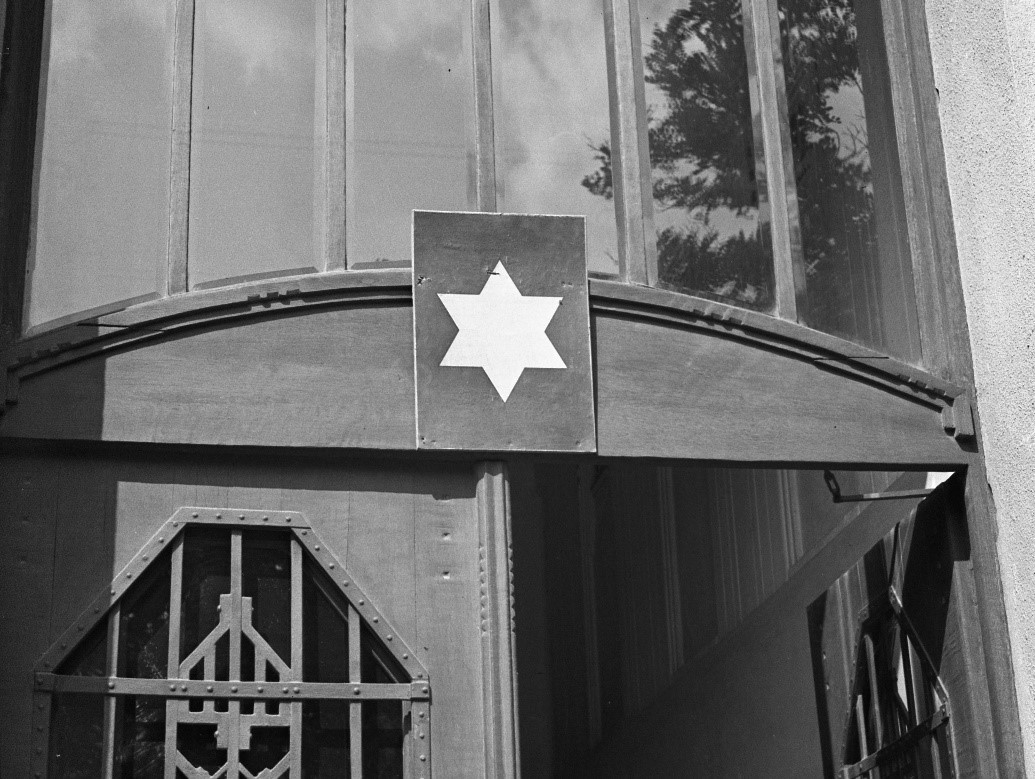
In the summer of 1944, the Hungarian authorities crammed some 200,000 Jewish residents of Budapest into 2,000 buildings scattered throughout the city, known as “yellow-star houses." The purpose of this ghettoization, referred to as "relocation," was to concentrate the Jews and place them under strict control prior to deportation.
The first steps
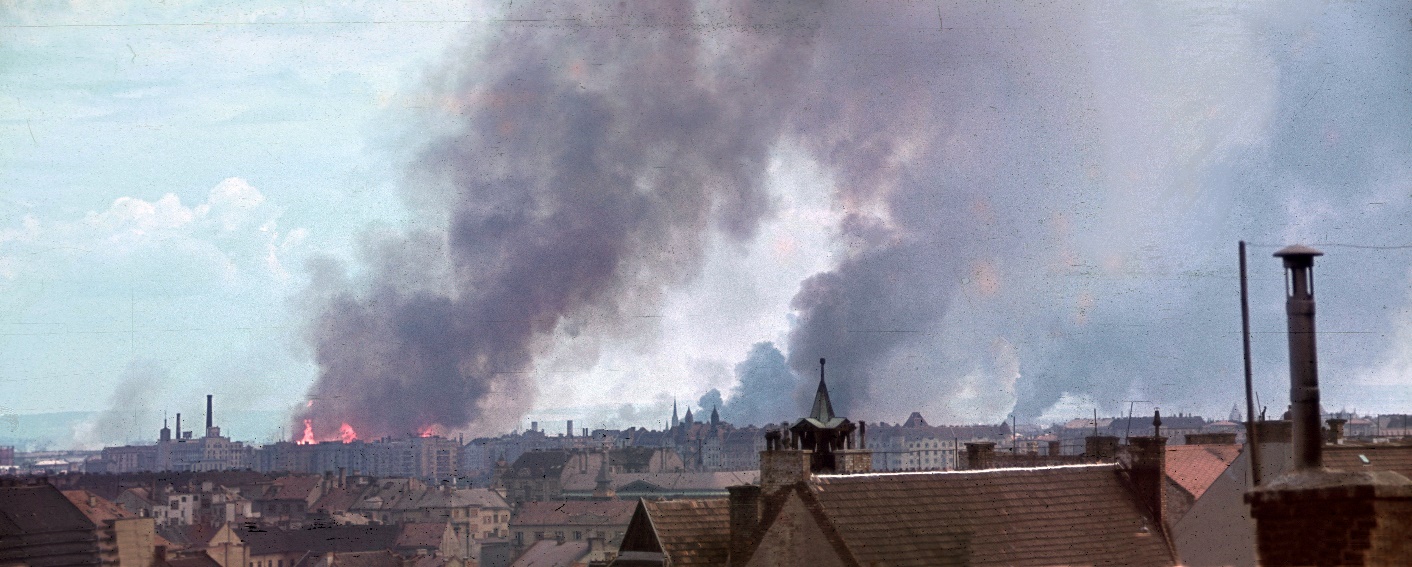
The precondition for the deportations from Budapest was the concentration of Jews in the capital. Endre and Eichmann wanted to move them as quickly as possible so that their deportation could proceed smoothly. The first step was taken when, following the large-scale Allied air raids of April 3 and 4, 1,500 Jewish homes in Budapest and the surrounding area were confiscated in a single day and given to Christians whose homes had been damaged by bombs. Behind this move was the antisemitic obsession—known not only in Hungary—that Jews were responsible for the Allied air strikes and, in some cases, were even "directing" the British and American pilots.
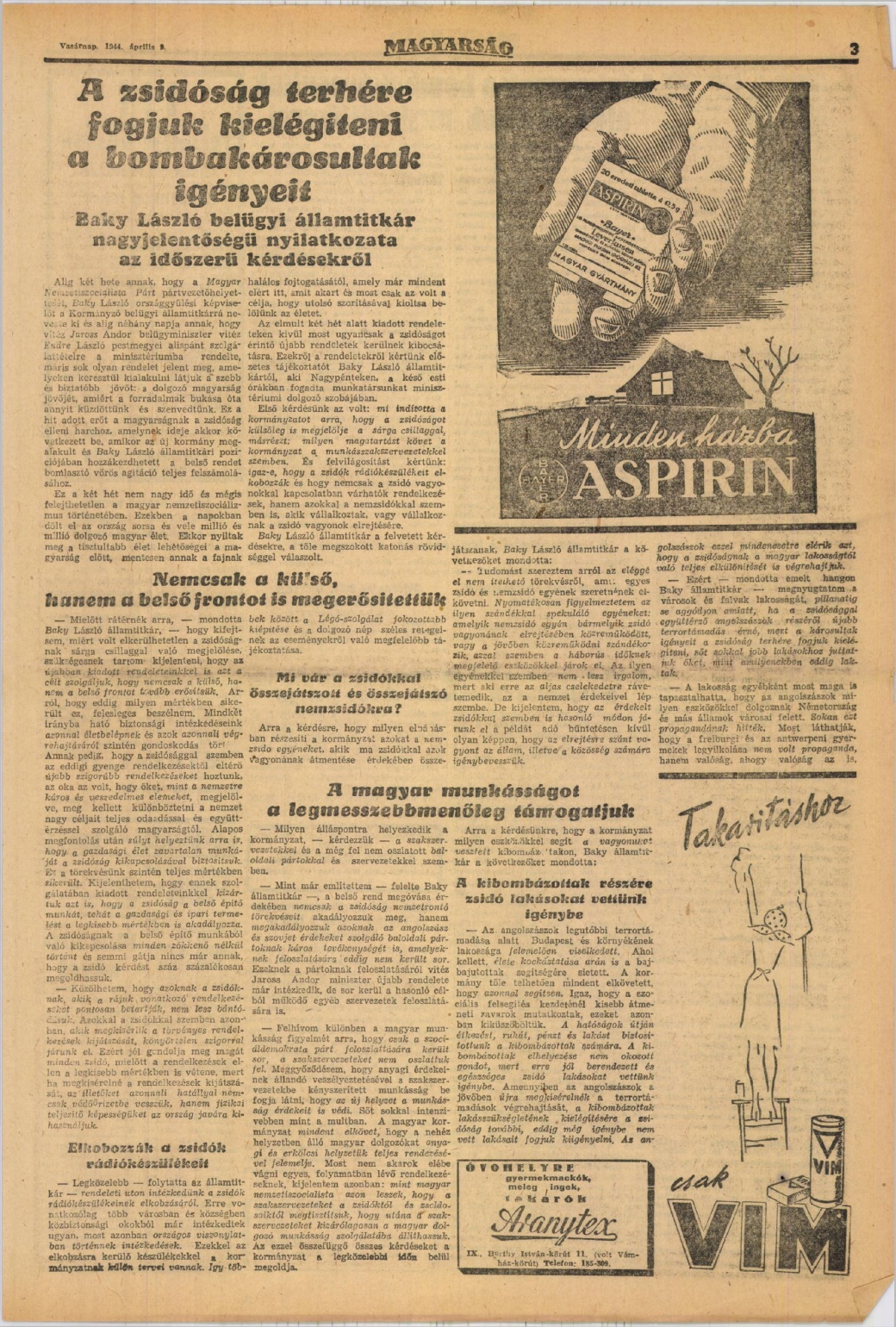
The Jews, who were driven out of their homes within hours, were to be moved by the authorities to Erzsébetváros and Terézváros, areas densely populated by Jews. Endre had already publicly outlined the concept of the ghettos that would later be established. On April 16, he made the following statement to the far-right newspaper Magyarság: “We do not want to concentrate the Jews in a single closed Jewish residential district. Everywhere where enemy terror bombers are likely to attack, such as factory buildings, railway stations, etc., we will concentrate a sufficient number of Jews. This concentration will take place in such a way that, in the future, certain apartment buildings will be occupied exclusively by Jews, meaning that Jews will move into so-called housing blocks. There will, of course, be larger areas, such as Dob Street and its surroundings, where only Jews will be allowed to live. Where possible, we will also create closed Jewish residential areas, i.e., we will completely isolate Jews from contact with non-Jews.”
Scattered blocks of houses or closed ghettos
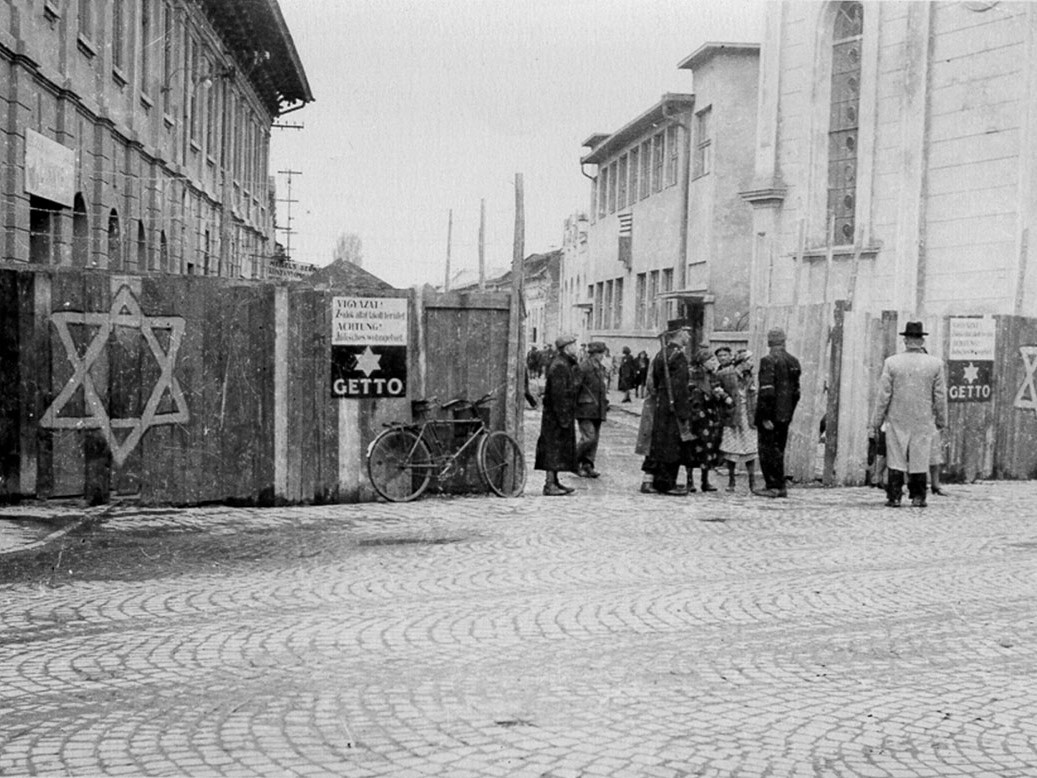
According to Endre's statement, no contiguous ghetto was established in Budapest until December 1944. In the summer of 1944, "only" scattered blocks of houses—so-called yellow-star houses—were designated as forced residences for Jews. This was considered a more favorable outcome than a closed and confined area. Some believe that this was thanks to the Jewish Council, who successfully spread the rumor that the Allies were considerate of the Jewish population. If the Jews were to be settled in an area isolated from the rest of the city, the rest of Budapest would become fair game for air raids. This absurd theory was drummed into the public by government representatives themselves, who claimed that the Jews were being punished for the bombings.
“If the Anglo-Saxons attempt to carry out terrorist attacks again in the future, we will requisition additional Jewish apartments that have not yet been used to meet the housing needs of those whose homes have been bombed. Therefore ... I reassure the inhabitants of towns and villages that they need not worry for a moment if the Anglo-Saxons, who sympathize with the Jews, carry out further terrorist attacks, because we will meet the needs of those affected at the expense of the Jews ...” said László Baky, State Secretary for Internal Affairs, to Magyarság on April 9.
This provided fertile ground for false reports spread by the Jewish leadership about secret ties between the Allies and the Jews and the selective targeting of bombers. Margit Tolnai Kassai, a bank clerk who, as a Jew, also had to move into a house marked with a star, recalled after the war that this belief persisted among the population: “Even an intelligent Christian acquaintance consoled me by saying he they would much rather live in a house marked with a star,” because bombs would not fall there. “When I asked him how he imagined this would work technically, he replied that the British had perfect instruments and would bomb from a low altitude.”
The 14 June issue of Függetlenség explained the government's decision: “Since the Jews live in the capital in such large numbers that complete segregation and the administration and practical solution would have taken a long time, the Ministry of the Interior is for the time being moving the Jews only to blocks of flats or to specially designated houses.”
Yellow-star houses, flood of applications
As soon as the deportation of Jews from the countryside had begun, Endre launched the ghettoization in Budapest at a frantic pace: on 26 May, he ordered the Budapest administration to designate Jewish and non-Jewish houses by 31 May. He then wanted to allow only 24 hours for the relocation process—affecting hundreds of thousands of people—to be carried out by the Jewish Council and the Budapest administration. A special alliance was formed between the otherwise far-right Budapest administration and the Council to extort a manageable deadline from Endre and the government. In the end, Endre was forced to concede: the mayoral decree of 16 June required the Jews to be moved out by 8 p.m. on 21 June.
The Jewish Council, through its central newspaper, The Magyarországi Zsidók Lapja (Journal of the Jews in Hungary), began to organize the moving as early as 15 June, calling on all Jews in the capital to “find a place for themselves with a relative or acquaintance living in a house in which the majority of the tenants are considered Jews according to the present regulations and which is expected to be a Jewish house.” The Jewish leadership also urgently invited applications from owners of transport vehicles and hand carts, as well as from carriers and loaders.
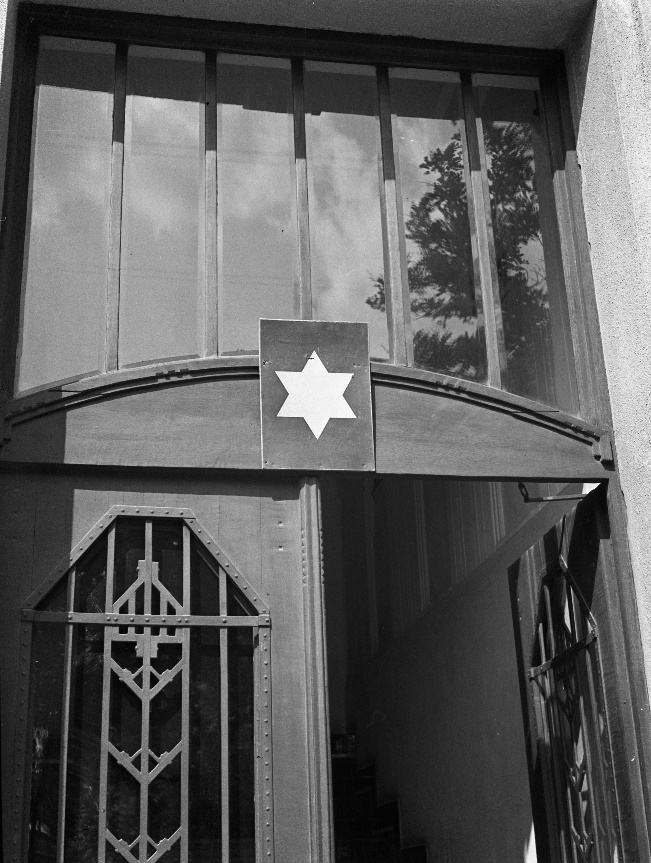
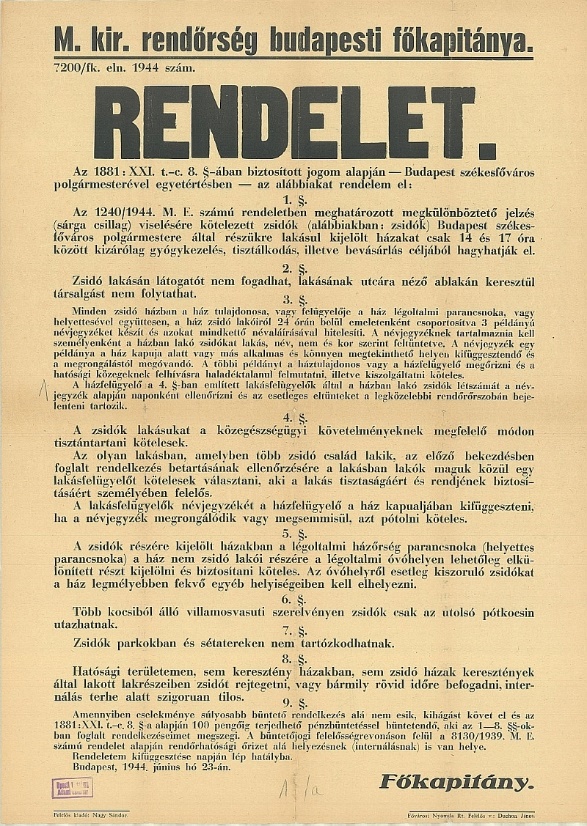
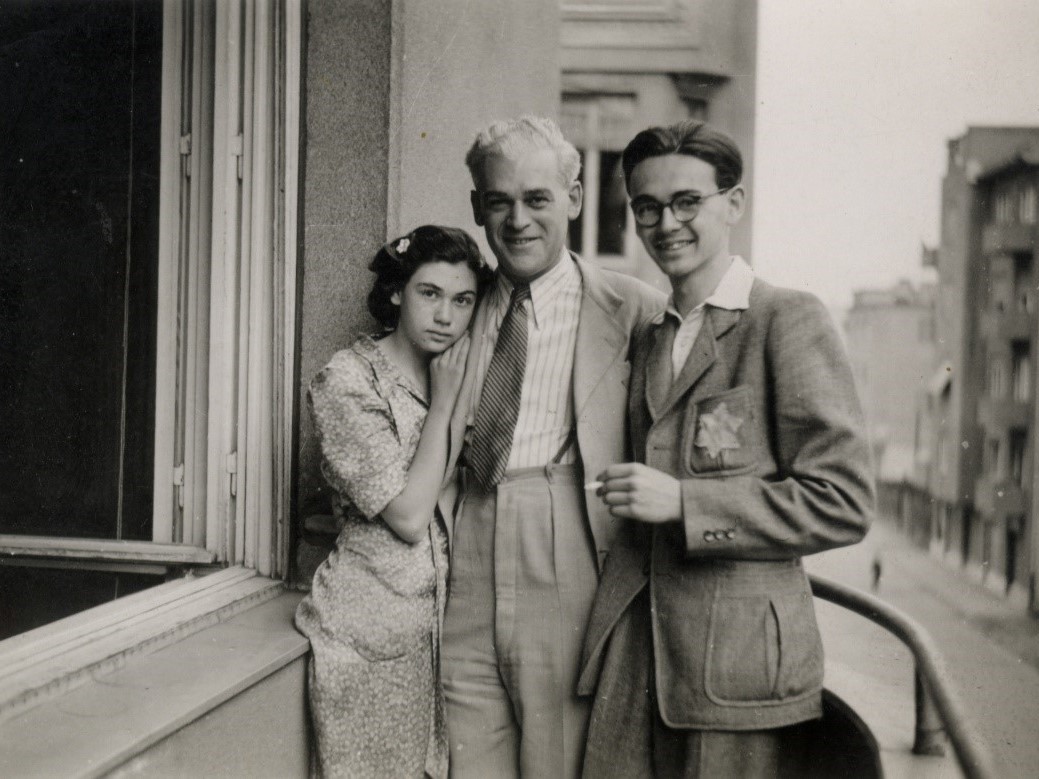
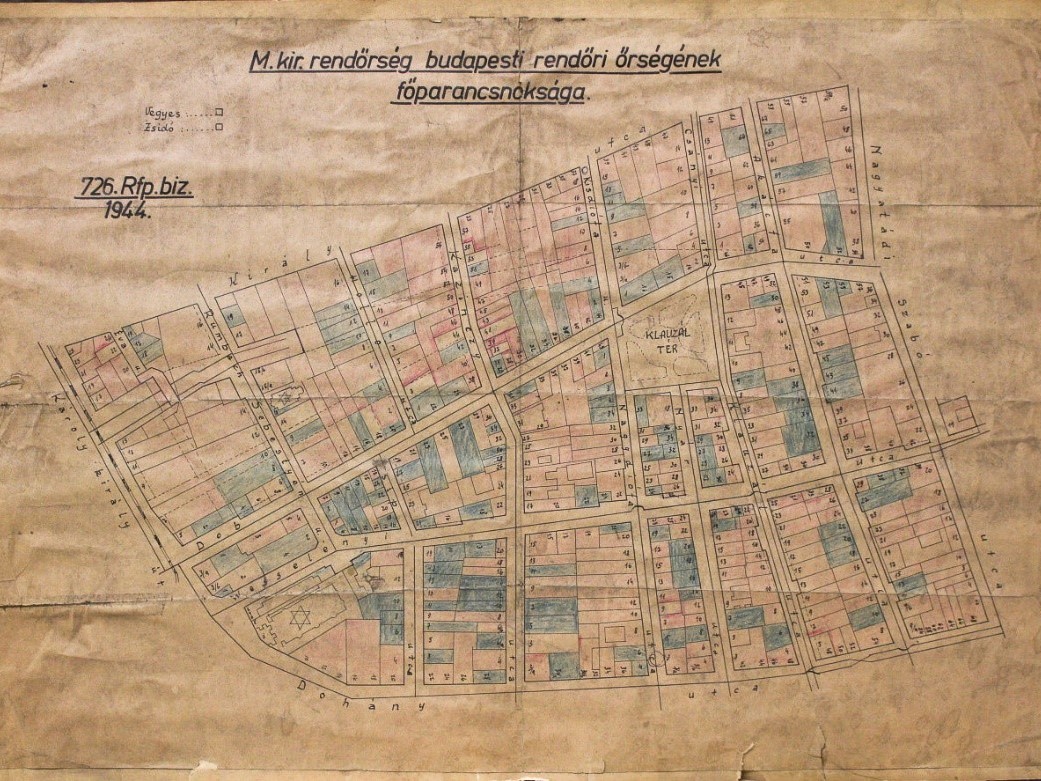
On 16 June, tens of thousands of wall stickers and posters appeared in the city, announcing that Mayor Farkas Ákos Doroghi had ordered the Jews to move in together. One Jewish family was entitled to one room. The decree designated 2,639 star-marked houses; from then on, Jews could only live in these, mainly in the Pest part of the city. According to the decree, a “canary yellow star with a diameter of 30 cm and a size of 51 × 36 cm on a black background with six points” had to be placed above all street entrances to the designated houses. Christian tenants in the designated buildings were supposed to move out of their homes. (This was eventually only done to a limited extent, resulting in the so-called “mixed houses,” where Jews and Christians lived together.) The plan was to compensate Christians who moved out with vacant Jewish properties. The primary consideration in the designation was that the majority of the homeowners and residents should be Jewish, thus simplifying the relocation process. The decision-makers also wanted to deprive Jews of well-located, modern properties.
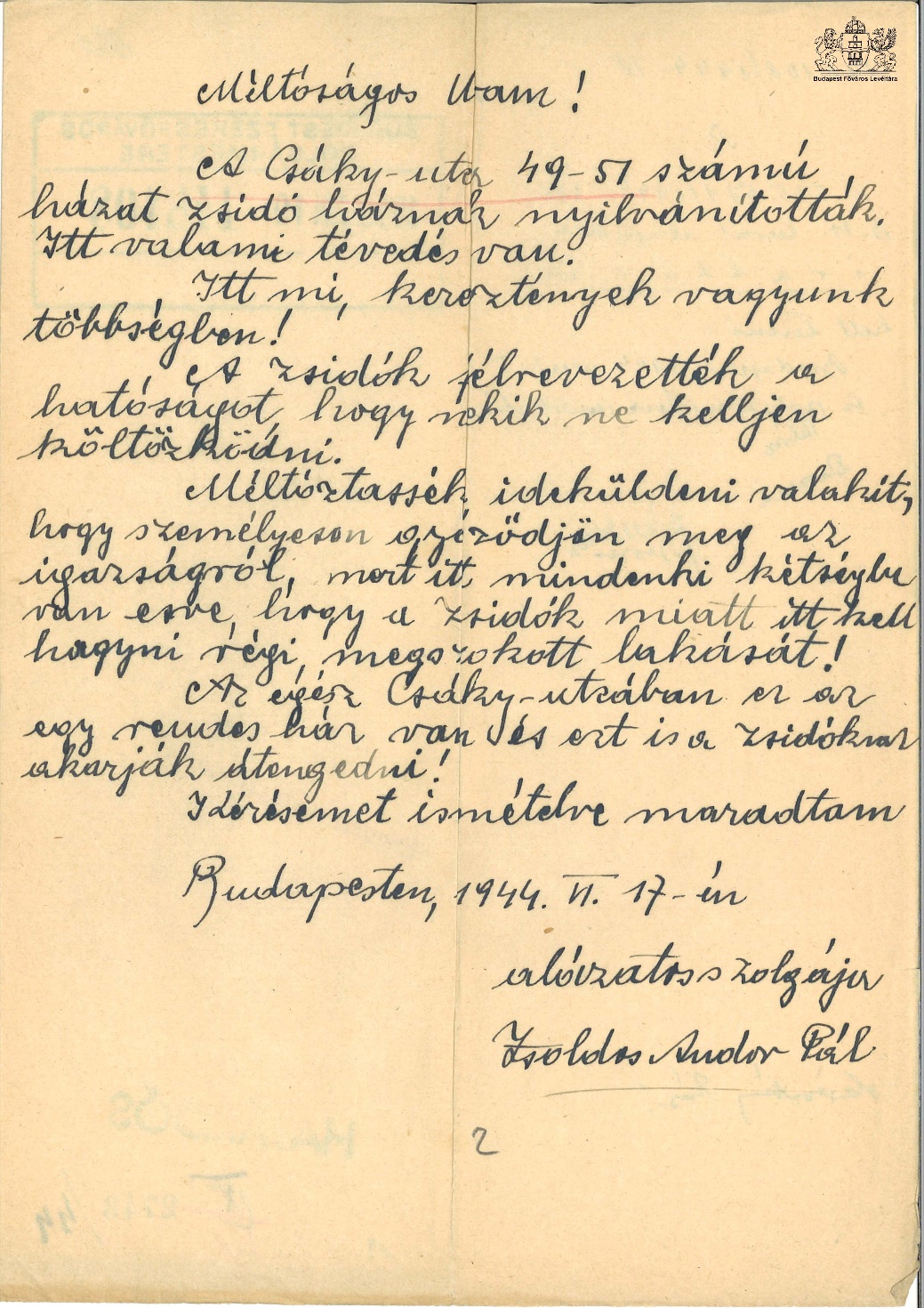
In the days that followed, the offices received a flood of petitions: Jews generally wanted their houses to be designated as yellow-star buildings, while Christians asked that their homes not be designated. József Szentmiklósi, the councilor in charge of the relocation on behalf of the capital, and who was otherwise friendly to the Jews, fled the flood of petitions and simply took a leave of absence. The capital placed most of the petitions in the archives but forwarded several hundred to Endre, who, of course, usually made decisions unfavorable to the Jews. Of the 2,639 starred houses, the authorities took several hundred of the list—including all properties that included villa-apartments—to non-Jewish property and ultimately designated considerably fewer buildings. This made the already desperate situation of the Jews much more difficult, both by significantly reducing the number of buildings available and by triggering a new wave of displacement among those who had already successfully settled in a building that had originally been designated but was then taken off the list of yellow-star houses.
It is clear that the authorities designated most of the yellow-star houses in the VI, VII, VIII, and (today's) XIII districts, which were mainly inhabited by Jews. The two Budapest ghettos established in the winter of 1944 would be located in the VII and XIII districts.
The other wave of petitions was initiated by Christians who wanted to take over vacant Jewish homes. The approximately 25,000 abandoned Jewish apartments sparked a frenzy among the non-Jewish population. Many arbitrarily broke the seals and moved into properties they liked. Others wanted to take the "legal" route and bombarded the capital's housing department with applications. The Pesti Hírlap reported on June 18 that a flood of housing applications had arrived at the office. Dr. Gusztáv Csanády, head of the capital's housing department, appeared before the public to say that that "in view of the large number of vacant apartments, the Minister of the Interior has decided to issue a special decree regulating how Christians can obtain apartments vacated by Jews ... Applications for apartments are therefore unnecessary and pointless for the time being." This did not dampen expectations. On June 29, according to a report in Új Magyarság, "the capital city's housing office at City Hall is being visited by such large crowds that there are scenes of mass unrest, which is undesirable in the current situation. The city leadership has repeatedly called on the public not to rush to the housing office, as housing allocations are suspended until further notice."
Locked up
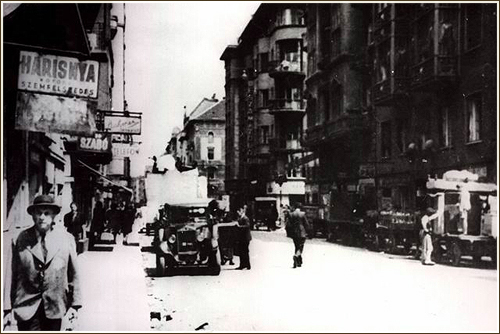
While a part of the Christian public in the capital went on a rampage to acquire the abandoned Jewish homes, the Jews were desperately trying to meet the deadline set by the decree. It soon became clear that they would not be able to complete the operation by the evening of the 21st. This was also evident to the authorities: the decree, which fixed the status of the houses on the Pest side, had already extended the deadline to midnight on 24 June. The Ministry of the Interior was no longer willing to grant a further extension but had promised the Council that Jews in non-star houses would not be arrested on the 25th, nor would those who completed their move on the 25th be harassed.
-
-
-
-
Budapest, Paris, Auschwitz. Budapest Jews and the Holocaust in France
-
Invasion, Police Raids, Internment. The German Occupation and the Budapest Jews
-
-
Star-Marked City. The First Ghettoization of the Budapest Jews
-
-
"In Poland, Jews are being gassed and burned." The Suspension of the Deportations
-
Chips on the Poker Table. The Fate of the Budapest Jews in August 1944
-
“They are being killed with gas and burned.” What did the Budapest Jews know and what could they do?
-
Großaktion Budapest. How would the Jews of Budapest have been Deported?
-
“The Danube was Red with Jewish Blood.” Arrow Cross Murders in Budapest
-
-
Death March, Brick Factory, Slave Labor. The Budapest Deportations in Late 1944
-
Ghetto and Liberation. Jews of Budapest at the End of the War
-
-
To Obey or Resist? Group and Individual Responses to Persecution in Budapest
-

-
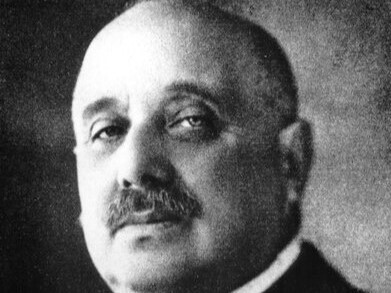
Fates in Budapest. The Founder of the Hungarian Pharmaceutical Industry: Gedeon Richter
-
-

Fates in Budapest. The Rosenthal Saga: Forced Labor, Bergen-Belsen and the "Horror Train"