Chips on the Poker Table. The Fate of the Budapest Jews in August 1944
After approving the deportations from the countryside, Regent Miklós Horthy spared the Jews of Budapest from the same fate. However, he eventually yielded to German pressure and agreed to resume the transports. Romania's withdrawal from the Nazi alliance changed the situation again, and the Jews of the capital were saved once more.
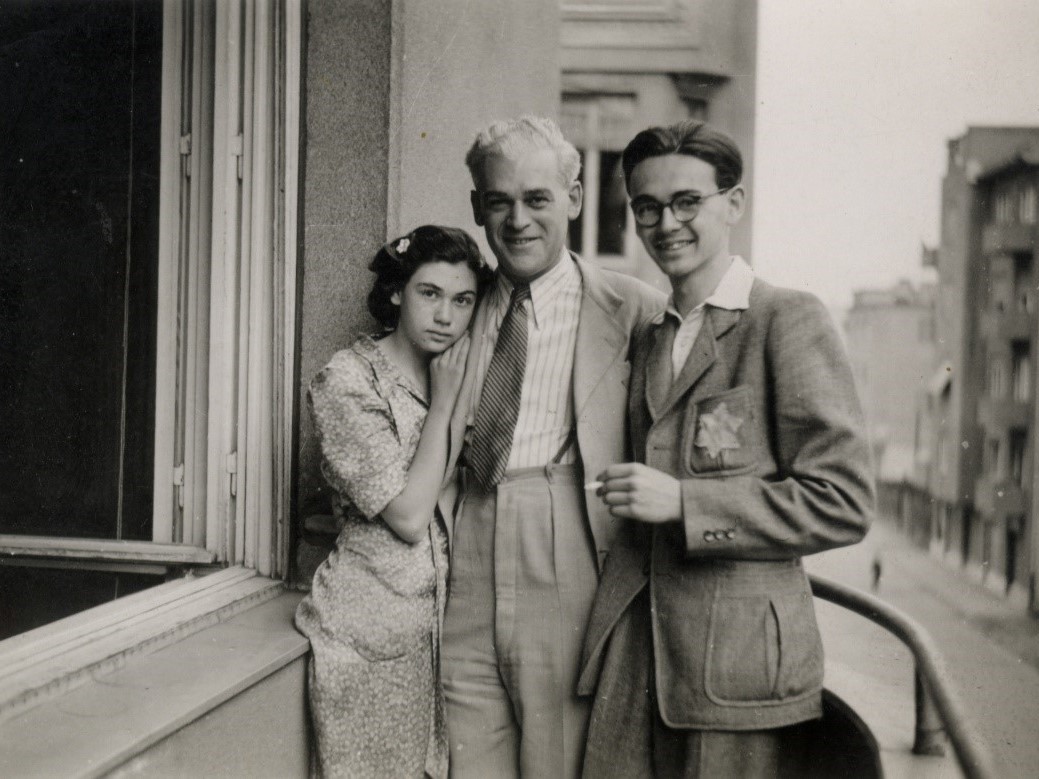
The suspension of deportations in July 1944 and the temporary escape of Jews from the capital did not bring relief to those persecuted in Budapest. Unable to accept defeat, Adolf Eichmann deported another 3,000 people (including many from Budapest) from the internment camps in Kistarcsa and Sárvár to Auschwitz during July. Due to resistance from the Hungarian authorities, he was unable to deport more people, but news of these events caused great anxiety among the Jews of the capital. In this situation, reports that one of the most influential members of the Jewish Council, the Orthodox Fülöp Freudiger, had fled to Romania with his family on August 9-10 came as a bombshell. From the fleeing of the well-informed Freudiger, many concluded that deportation was imminent.
Mounting pressure
They were right. During July-August, Horthy and those around him tried to withstand the pressure on the Regent and somehow navigate in the shrinking room for maneuvering, with moderate success. Berlin demanded a resumption of deportations while the Western Allies and neutral countries wanted Horthy to deny Nazi demands. The goodwill of the Westerners was vital for him as he had long been planning for Hungary’s quitting the Nazi alliance, but for the time being he did not want to risk an all-out confrontation with Hitler. The majority of his own government worked against Horthy to resume deportations and enjoyed the support of an active part of the Hungarian political elite. Meanwhile, the military situation of the Germans—and thus of Hungary—was constantly deteriorating in both the east and the west.
Hitler personally demanded, repeatedly, that the Jews of Budapest be liquidated. As early as July 17, he told Horthy that they should be deported “without further delay”. On the 21st in Berlin, the Führer spoke at length to the Regent’s personal envoy, Colonel General Béla Dálnoki Miklós, about the need to deport the remaining Jews. On July 29, on Berlin's instructions, Edmund Veesenmayer, Hitler’s envoy to Hungary, demanded that Hungary "immediately continue to deport the Jews."
While Horthy had to be convinced, the collaborating government did not. At the government meeting on August 2, Prime Minister Sztójay Döme assumed that "the deportation of Jews would begin again in a week or two." Minister of the Interior Andor Jaross suggested that everyone except 20,000 Christian Jews (converts) should be deported, first from Districts 6, 7 and 8. On the 10th, the government discussed the transfer of 50 to 60,000 “Galician and other infiltrator Jews” to meet Berlin’s demands.According to a note from the German embassy dated August 15, the deportations were to begin on the 20th, on St. Stephen Memorial Day.However, it is unlikely that the Hungarian authorities would have timed the large-scale operation for the state holiday routinely coinciding with the initiation ceremony for military officers. However, Miklós Bonczos, the new interior minister appointed to replace Jaross, promised Eichmann on August 19 that transports could begin on August 25, with the exception of the 3,000 Jews who had been exempted by the Regent and those baptized before August 1, 1941.
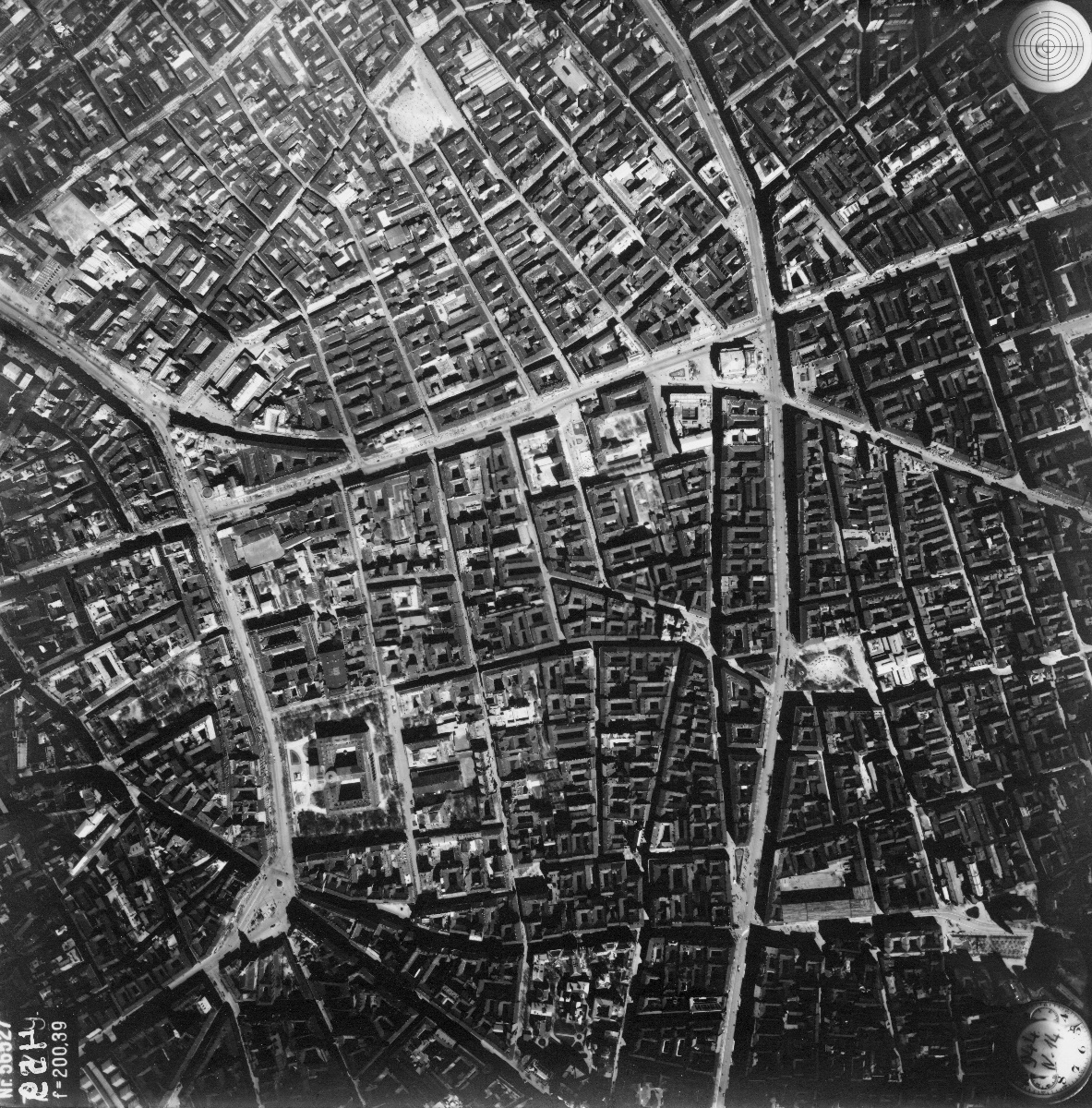
On August 23, the Regent's office (i.e., Horthy's immediate administrative surroundings) sent a draft German-Hungarian government agreement to the Ministry of Foreign Affairs. This would have "made available" to Germany, in addition to 55-60 thousand labor servicemen, an unspecified number of Jews who constitute "a danger to public order, public food provisioning, the internal security of the country." The Hungarian government would have decided who they were - so anyone could be deported. The action would have commenced on 28 August. In return, the government requested the departure of Eichmann and his men and that the Jewish question come under Hungarian jurisdiction alone. The Council of Ministers passed the draft on 25 August, but the initiative eventually did not come into effect.
The picture that emerges from the documents is clear. At a meeting of the Council of Ministers, the Deputy Foreign Minister had already informed the government two months earlier (on 21 June) that there were articles in the foreign press about the "extermination of Jews in Hungary" and that "Jews in Poland are being gassed and burned". The Regent and the ministers were aware of the so-called Auschwitz Protocol, the detailed accounts of the massacre of Slovak Jews who had fled Birkenau. Nonetheless, it appears that by the second half of August, Horthy and his entourage had finally bowed to German claims and were ready to begin the (at least partial) deportation within days.
Horthy was not the only one who saw the Jews in the capital as the key to his political survival. Behind Hitler’s back, the head of the SS, Heinrich Himmler, sought contacts with Western Allies. He secretly offered 1 million Jews in exchange for 10,000 trucks and peace talks. The “offer” was not taken seriously, but if the bizarre transaction had actually occurred, the people of Budapest would obviously have been among the people handed over. The fate of the Jews in the capital these weeks was a chip on the poker table of a global political game.
German preparations
Meanwhile, the German police force was preparing for the deportations from Budapest with full force. Eichmann and László Endre feverishly coordinated with the new head of the SIPO (Sicherheitspolizei - Security Police), SS Major Reiner Gottstein. Gottstein was known as a rabid antisemite in SS circles. Even Himmler's special envoy to Hungary, Kurt Becher, said he was "strict" about Jews. Earlier in the spring, after the German occupation, Gottstein became the German police commander in Kassa (today: Košice, Slovakia). In this capacity, on April 1, just two weeks before the start of the nationwide operation to round up Jews in ghettos, he was the first to initiate that Hungarian police and gendarmerie begin the “resettlement” of Jews living in Carpatho-Ruthenian villages to Munkács (today: Munkacevo, Ukraine), Ungvár (Uzhhorod) and Beregszász (Beregovo).His demand caused serious turmoil in the Hungarian government. In the end, the relocation of the Jews was delayed only because of resistance from the army. In the summer, the then Budapest police chief, SS Lieutenant Colonel Alfred Trenker, was sent to Berlin to take part in the investigations related to the July 20 assassination attempt against Hitler. Gottstein took his place and his appointment was an ominous development. In addition to Endre, Eichmann and Gottstein, SS General Otto Winkelmann, head of the SS and German police forces in Hungary, was also involved in the preparations for the Budapest deportations.
On August 15, the Economic and Administrative Main Office of the SS (Wirtschafts-Verwaltungshauptamt), which supervised the concentration camps, anticipated the arrival of 90,000 new Hungarian Jewish slave laborers. One of the department heads indicated to his superiors that barely any of the clothes of Hungarian Jews previously deported and killed in Auschwitz-Birkenau were left available in the warehouses, so the new prisoners (from Budapest) would not be able to get dressed. In Budapest, probably as a preparatory measure, three leaders of the Jewish Council were arrested for two days by the Germans, and Eichmann ordered a list of all Council employees. He assigned one of his most experienced executors, Siegfried Seidl, the former commander of the Theresienstadt ghetto, to Budapest. Earlier in the spring, the SS captain directed the deportation of the Jewish communities of Nyíregyháza, Marosvásárhely (today: Târgu Mureş, Romania) and other areas. In August 1944 he supervised Hungarian Jews in Eastern Austria who were deported there in June 1944. His assignment in Budapest lasted until mid-September, the end of the planned deportation operation in the capital.
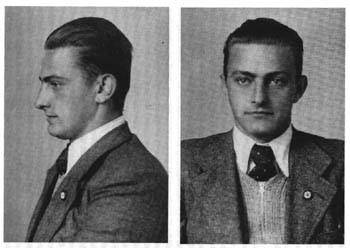
The decision had been made, and preparations were underway. The date for the deportation of the Budapest Jews was probably set for August 25. In the end, the operation was postponed again, due to developments in Bucharest on August 23.
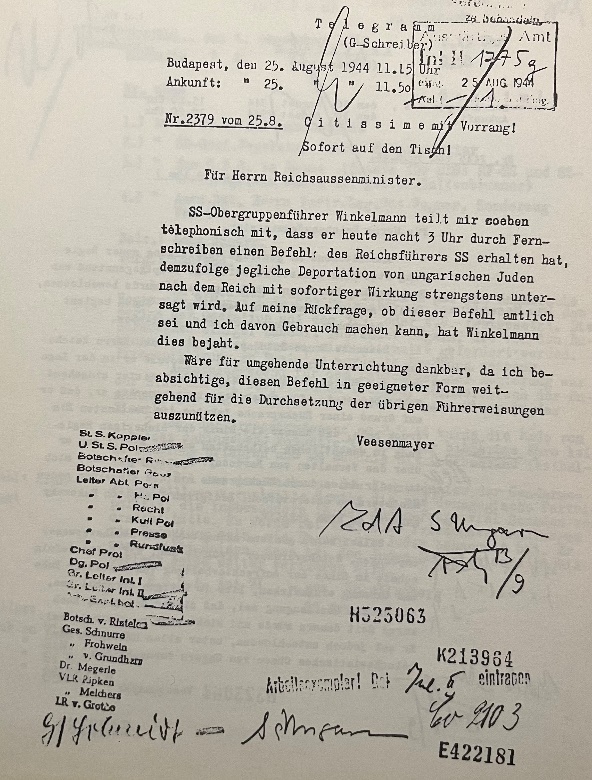
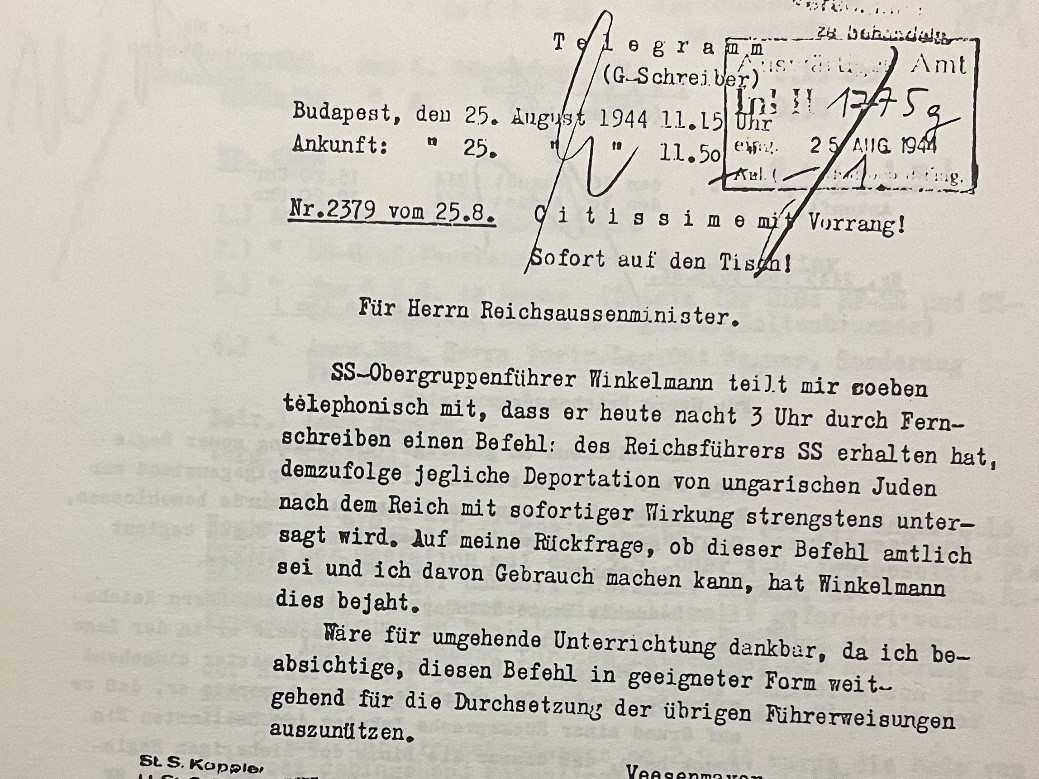
Seeing the successful advance of the Red Army in Bucharest, the Romanian pro-royal military group overthrew Marshal Antonescu on Wednesday, August 23, and Romania switched to the Allies. The next day, Horthy summoned the German ambassador Veesenmayer and told him that the Jews would not be extradited to Germany. He promised to remove them and lock them in camps outside Budapest. According to Veesenmayer’s report, the Regent also added, "he is willing to exterminate the Jews if they make the slightest trouble." Eichmann was informed by the Ministry of the Interior that the deportations had been stopped, and, seeing the situation, he asked his supervisors to summon him back from Budapest. Berlin responded to the news at 3 a.m. on August 25th. The head of the SS, Heinrich Himmler, "strictly forbade ... any deportation of Hungarian Jews to the Reich ... with immediate effect”.
-
-
-
-
Budapest, Paris, Auschwitz. Budapest Jews and the Holocaust in France
-
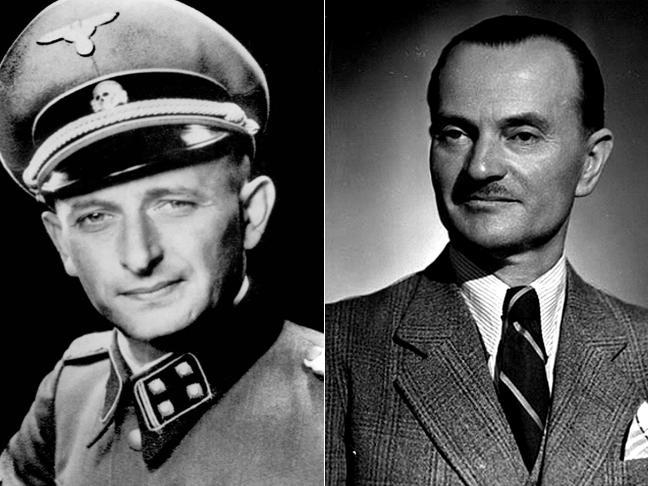
Invasion, Police Raids, Internment. The German Occupation and the Budapest Jews
-
-
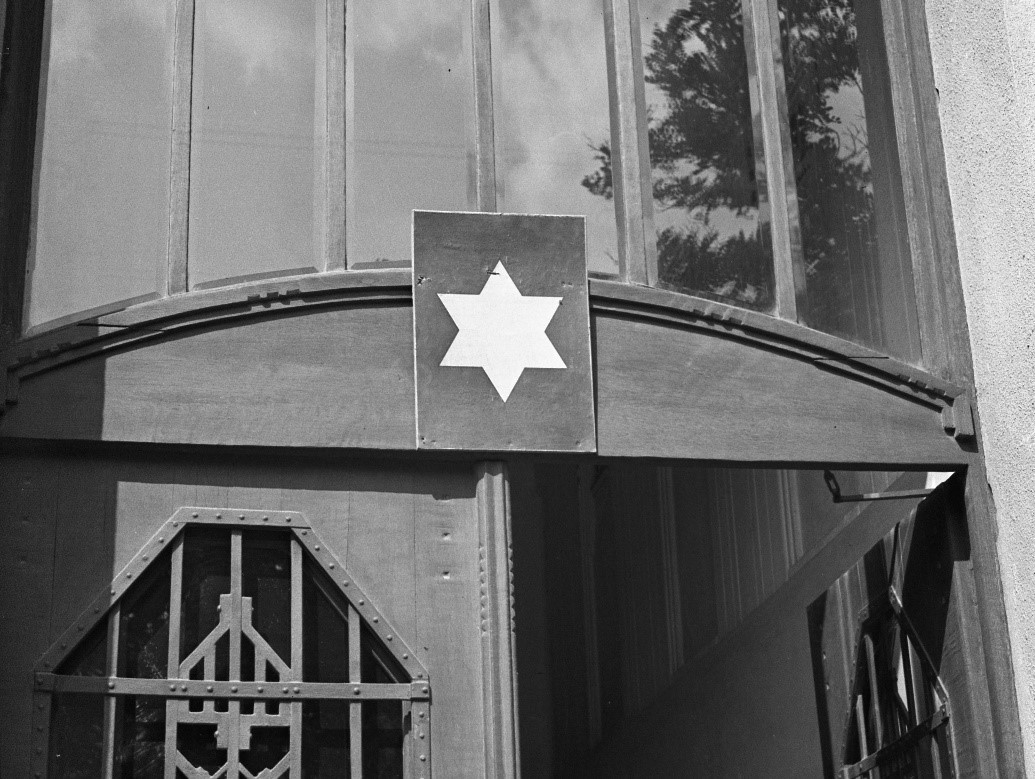
Star-Marked City. The First Ghettoization of the Budapest Jews
-
-
"In Poland, Jews are being gassed and burned." The Suspension of the Deportations
-
Chips on the Poker Table. The Fate of the Budapest Jews in August 1944
-
“They are being killed with gas and burned.” What did the Budapest Jews know and what could they do?
-
Großaktion Budapest. How would the Jews of Budapest have been Deported?
-
“The Danube was Red with Jewish Blood.” Arrow Cross Murders in Budapest
-
-
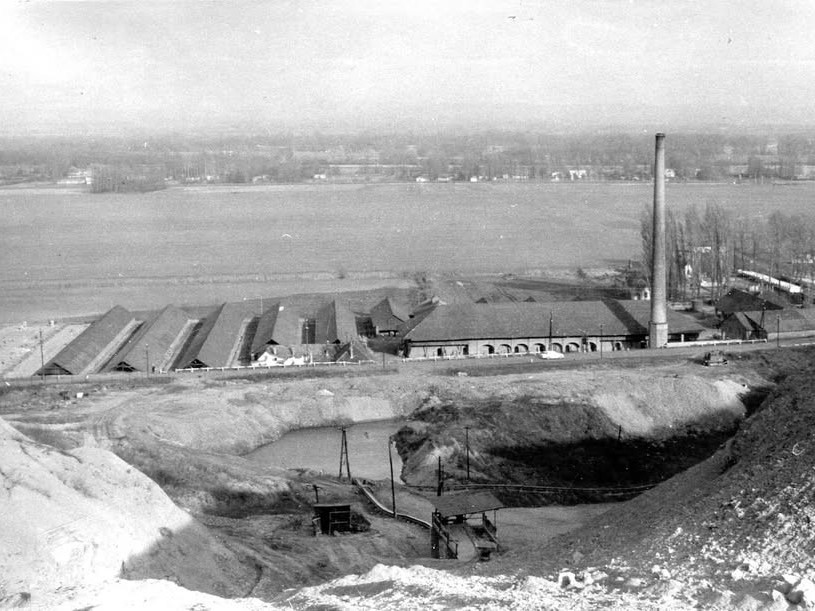
Death March, Brick Factory, Slave Labor. The Budapest Deportations in Late 1944
-
Ghetto and Liberation. Jews of Budapest at the End of the War
-
-
To Obey or Resist? Group and Individual Responses to Persecution in Budapest
-
-
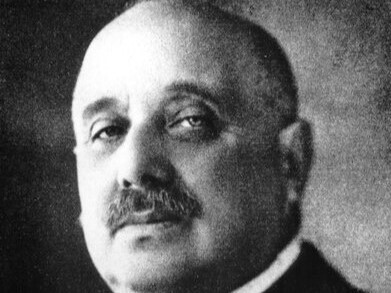
Fates in Budapest. The Founder of the Hungarian Pharmaceutical Industry: Gedeon Richter
-
-
Fates in Budapest. The Rosenthal Saga: Forced Labor, Bergen-Belsen and the "Horror Train"